
Modernising Healthcare Data Centres for Clinical-Critical Environments
Delivering resilient, compliant, and energy-efficient infrastructure to protect patient care
Across the NHS, hospitals increasingly rely on digital systems to support clinical decision-making, diagnostics, patient records, and operational continuity. From electronic health records and imaging systems to real-time monitoring and clinical communications, healthcare IT infrastructure has become mission critical.

In these environments, power reliability is not a technical consideration, it is a clinical requirement. Any interruption to IT services has the potential to impact patient safety, clinical workflows, and regulatory compliance.
To address these challenges, on365 delivered a turnkey data centre project for a UK NHS hospital, providing a fully resilient, scalable, and energy-efficient on-premise facility designed specifically for healthcare operations.
Delivered via a large IT managed services organisation, with on365 responsible for the end-to-end data centre design, integration and commissioning, the project involved the end-to-end design, supply, installation, and commissioning of a new hospital data centre environment, supporting critical clinical and operational systems.
Unlike legacy estates, this clean-environment deployment allowed resilience, redundancy, and efficiency to be embedded into the design from day one. on365 took full responsibility for the integration of power, cooling, containment, monitoring, and management systems, delivering a single, accountable solution aligned to NHS operational and compliance requirements.
The project demonstrates how modern healthcare data centres can be engineered from the outset to meet the demanding requirements of clinical environments.
The Challenge: Designing for Clinical-Critical Resilience
Although delivered as a clean-environment deployment, the data centre still had to meet the same clinical-critical constraints found across NHS estates, where availability, safety and compliance are non-negotiable.
Healthcare environments present a unique set of challenges for data centre design:
- Zero tolerance for downtime impacting patient-facing systems
- Highly sensitive medical and diagnostic equipment affected by power quality
- Strict compliance, safety, and change control requirements
- Physical constraints within hospital estates
- Restrictions on hot works and intrusive installation methods
In addition, healthcare data centres must support growing digital workloads while reducing energy consumption and operational costs, all within publicly funded environments.
A Design-Led, Turnkey Approach
on365 adopted a design-led approach, engineering resilience, efficiency, and operational visibility into every layer of the solution.
Rather than focusing on individual components, the project was delivered as an integrated system, covering:
- Fully redundant power
- High-efficiency cooling aligned to rack-level heat loads
- Thermal containment optimised for the room layout
- Integrated environmental and security monitoring
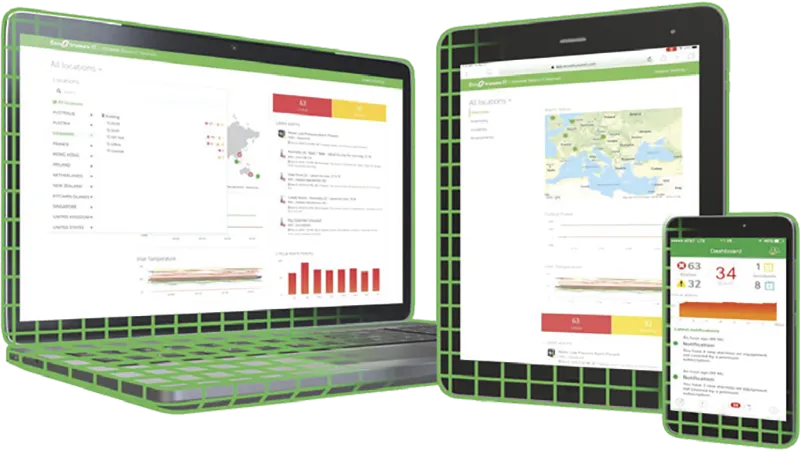
- Centralised DCIM for visibility and control
- Comprehensive commissioning and validation
Targeted Technology, Measurable Value
on365 applied Schneider Electric solutions in highly specific ways, ensuring that every technology deployed delivered tangible business outcomes in a live, regulated environment
Solution
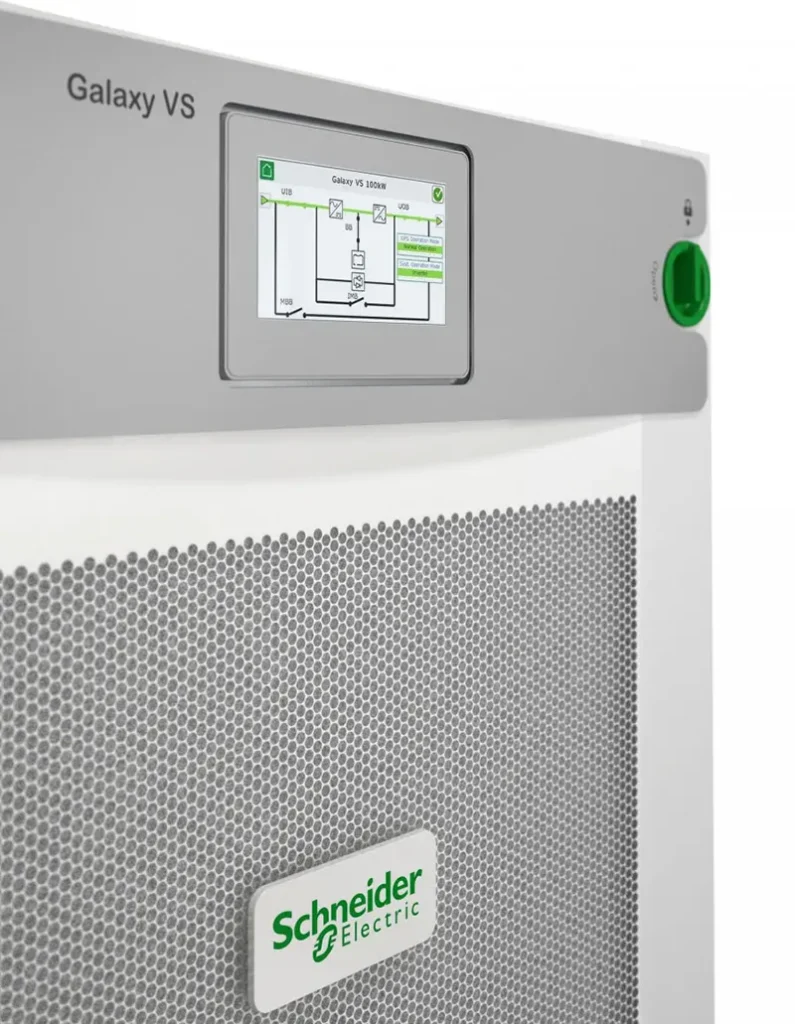
Galaxy VS UPS (2N Configuration)
Function / Deployment
2 × Galaxy VS 80 kW UPS systems configured in full 2N, isolated dual-fed architecture with service bypass and switchgear
Business Value Delivered
Continuous availability of clinical systems; elimination of single points of failure; safe maintenance without disruption to patient services; compliance with healthcare resilience requirements
Solution
Lithium-Ion Battery Systems (Type E)
Function / Deployment
Lithium-ion battery systems deployed per UPS
Business Value Delivered
Reduced footprint in constrained hospital plant rooms; lower maintenance burden; improved lifecycle cost; higher reliability compared to VRLA batteries
Solution
Modular Power Distribution (PDPM277H)
Function / Deployment
2 × modular power distribution cabinets providing isolated A & B feeds to each rack and cooling unit
Business Value Delivered
Resilient, scalable power delivery; simplified expansion; improved fault isolation; enhanced operational safety in live healthcare environments
Solution
NetShelter™ AR3350 Racks
Function / Deployment
12 racks deployed at 5 kW per rack (60 kW total HAC load)
Business Value Delivered
Secure, standardised IT housing; predictable thermal and power performance; support for future clinical system growth
Solution
InRow DX Cooling (ACRD301S Gen2)
Function / Deployment
4 × InRow DX cooling units with outdoor condensing units delivering 60 kW N+1 cooling
Business Value Delivered
High-availability cooling for clinical IT loads; close-coupled cooling improves efficiency; resilience against single unit failure
Solution
EcoAisle™ Thermal Containment (HACS)
Function / Deployment
Hot-aisle containment system adapted for wall-adjacent layout; integrated aisle LED lighting N+1 cooling
Business Value Delivered
Improved cooling efficiency; stable operating temperatures for critical systems; reduced energy consumption; safer working environment for hospital IT teams
Solution
NetBotz™ Monitoring
Function / Deployment
Rack, pod, and room-level environmental and security monitoring
Business Value Delivered
Real-time operational visibility; proactive risk management; simplified compliance reporting; faster response to potential threats to clinical availability
Solution
EcoStruxure™ IT Expert (DCIM)
Function / Deployment
Centralised monitoring, alerting, and reporting platform
Business Value Delivered
Enhanced life safety; protection of critical clinical infrastructure; compliance with healthcare fire and safety standards
Solution
Fire Suppression & Drop-Out Ceiling (HACS)
Function / Deployment
Integrated fire suppression and ceiling system within the contained aisle
Business Value Delivered
Enhanced life safety; protection of critical clinical infrastructure; compliance with healthcare fire and safety standards
Solution
Full M&E Services & Commissioning
Function / Deployment
Complete mechanical and electrical installation using compression pipework; commissioning with rack heat load simulators and IST
Business Value Delivered
Reduced installation risk in live hospital environment; no hot works; validated performance before go-live; assurance of clinical system resilience
Resilient Power Architecture for Healthcare
At the core of the solution was a fully engineered, fully redundant power architecture designed specifically for clinical-critical environments, where even short interruptions to IT services can have patient safety implications.
The data centre was designed to support a 12-rack environment at 5 kW per rack, delivering a total 60 kW hot aisle containment (HAC) load, using Schneider Electric NetShelter™ AR3350 racks. From the outset, the design focused on eliminating single points of failure while maintaining simplicity, serviceability, and compliance with healthcare operational requirements.
End-to-End 2N Power Resilience
Power resilience was delivered through a true 2N architecture, providing full electrical redundancy from utility input through to rack-level distribution:
- 2 × Galaxy VS 80 kW UPS systems, configured for 2N operation, delivering isolated dual power paths from input to output
- Lithium-ion battery systems (Type E) deployed per UPS, reducing footprint, maintenance requirements, and total cost of ownership while improving battery lifecycle performance
- Dedicated input supply breakers and service bypass panels, enabling safe maintenance without impacting live clinical systems
Rack-Level Power Distribution
To ensure resilient delivery of power to IT loads, each rack was equipped with:
- Dual isolated A and B power feeds to every rack
- Two vertically mounted rack PDUs per rack, providing A & B power distribution
- Each PDU delivering 36 × C13 and 6 × C19 outlets, supporting a wide range of clinical and IT equipment
Output power distribution was managed via 2 × PDPM277H modular power distribution cabinets, located within the HAC, providing resilient feeds to both IT racks and cooling infrastructure.
This architecture ensures continuous availability of critical systems, even during maintenance or component failure, a fundamental requirement in hospital environments.
Integrated Cooling, Containment and Supporting Infrastructure
Power resilience was complemented by a cooling and containment design engineered to match the deployed load and physical constraints of the space:
- 4 × ACRD301S Gen2 InRow DX cooling units, delivering 60 kW N+1 cooling capacity, paired with dedicated outdoor condensing units
- 4 × ACCU302D outdoor condensing units, installed on Big Foot support systems to avoid roof penetration and simplify maintenance
- Pipework installed using a compression pipe system, enabling full M&E delivery without hot works, a critical requirement in live hospital estates
Thermal containment was delivered using Schneider Electric EcoAisle™ containment in a Hot Aisle Containment System (HACS) configuration, adapted to the room layout:
- Single-sided aisle door configuration where the aisle bordered a wall
- Integrated aisle LED lighting to improve safety and maintainability
- Fire suppression system and drop-out ceiling integrated within the HACS
Monitoring, Commissioning and Assurance
Operational assurance was embedded into the solution through:
- NetBotz™ monitoring deployed at rack, pod, and room level
- Integration with EcoStruxure™ IT for centralised DCIM visibility
- Continuous monitoring of environmental conditions and physical security
The project concluded with full commissioning, including:
- Rack heat load simulation
- Integrated Systems Testing (IST)
- Verification of power, cooling, containment, and monitoring systems operating as a single, resilient environment
This ensured the data centre was validated under realistic operating conditions before being handed over for clinical use.
A Repeatable Model for NHS and Healthcare Environments

This project demonstrates how healthcare data centres can be delivered as fully integrated, resilient, and efficient environments, supporting clinical services today while providing a scalable platform for future digital healthcare initiatives.
Whether modernising existing estates or delivering new hospital facilities, this approach provides NHS organisations with confidence that their critical infrastructure is designed to support patient care without compromise.
Supporting Resources
Technical papers and supporting documentation related to this project and the underlying Schneider Electric technologies.
White Paper
- How Modern DCIM Addresses CIO Management Challenges within Distributed, Hybrid IT Environments
- Cybersecurity Guidance for Data Center Power and Cooling Infrastructure Systems
- Why Data Centers Must Prioritize Environmental Sustainability: Four Key Drivers
- Recommended Inventory for Data Center Scope 3 GHG Emissions Reporting
- A Quantitative Comparison of UPS Monitoring and Servicing Approaches Across Edge Environments
- Improving Rack Cooling Performance Using Airflow Management™ Blanking Panels
- How Higher Chilled Water Temperature Can Improve Data Center Cooling System Efficiency
- The Unexpected Impact of Raising Data Center Temperatures
- Guidance for Calculation of Efficiency (PUE) in Data Centers
- Implementing Hot and Cold Air Containment in Existing Data Centers
- Energy Impact of Increased Server Inlet Temperature
- Impact of Hot and C old Aisle Containment on Data Center Temperature and Efficiency